Annual Reports
Verizon Communications Inc.'s annual reports contain management's most considered account of the business. These are the sections, passages and visual pages worth opening in the originals preserved in Sources.
Verizon Communications Inc. — FY2025 Annual Report (Form 10-K) — FY2025
The latest 10-K, written just after the Frontier close and a reset $55B capital-return plan — the clearest single account of the business today. · Open the full document →
Item 1. Business — p. 5 · Read the full section →
Verizon in its own words: two segments — Consumer (77% of revenue) and Business — and the wireless, fiber and FWA networks that carry them.
The two-segment structure, with each segment's 2025 revenue and share of the consolidated total.
We have two reportable segments that we operate and manage as strategic business units - Verizon Consumer Group (Consumer) and Verizon Business Group (Business). […] In 2025, the Consumer segment’s revenues were $106.8 billion, representing approximately 77% of Verizon’s consolidated revenues. […] In 2025, the Business segment's revenues were $29.1 billion, representing approximately 21% of Verizon’s consolidated revenues.
p. 5 · Read in context →
Item 1A. Risk Factors — p. 19 · Read the full section →
Company-specific risks that could genuinely bite: a heavily unionized workforce and a capital-return pledge management calls not guaranteed.
About 27% of the workforce is unionized (CWA/IBEW); contract renegotiations risk added cost or work stoppages.
As of December 31, 2025, approximately 27% of our workforce is represented by the Communications Workers of America or the International Brotherhood of Electrical Workers. With subsequent negotiations we could incur additional costs and/or experience work stoppages, which could adversely affect our business operations.
p. 25 · Read in context →
The January 2026 pledge to return about $55B through 2028, incl. a $25B buyback — explicitly not guaranteed.
In January 2026, we announced that we believed that our strategic plans would provide us with the capacity to return approximately $55 billion to our shareholders, in the form of dividend payments and share repurchases, through the end of 2028. At that time, the Board of Directors of the Company authorized a share repurchase program of up to $25 billion, as well as a dividend increase, and we stated that we expected to repurchase at least $3 billion of our common stock during 2026.
p. 31 · Read in context →
Item 7. Management's Discussion and Analysis — p. 39 · Read the full section →
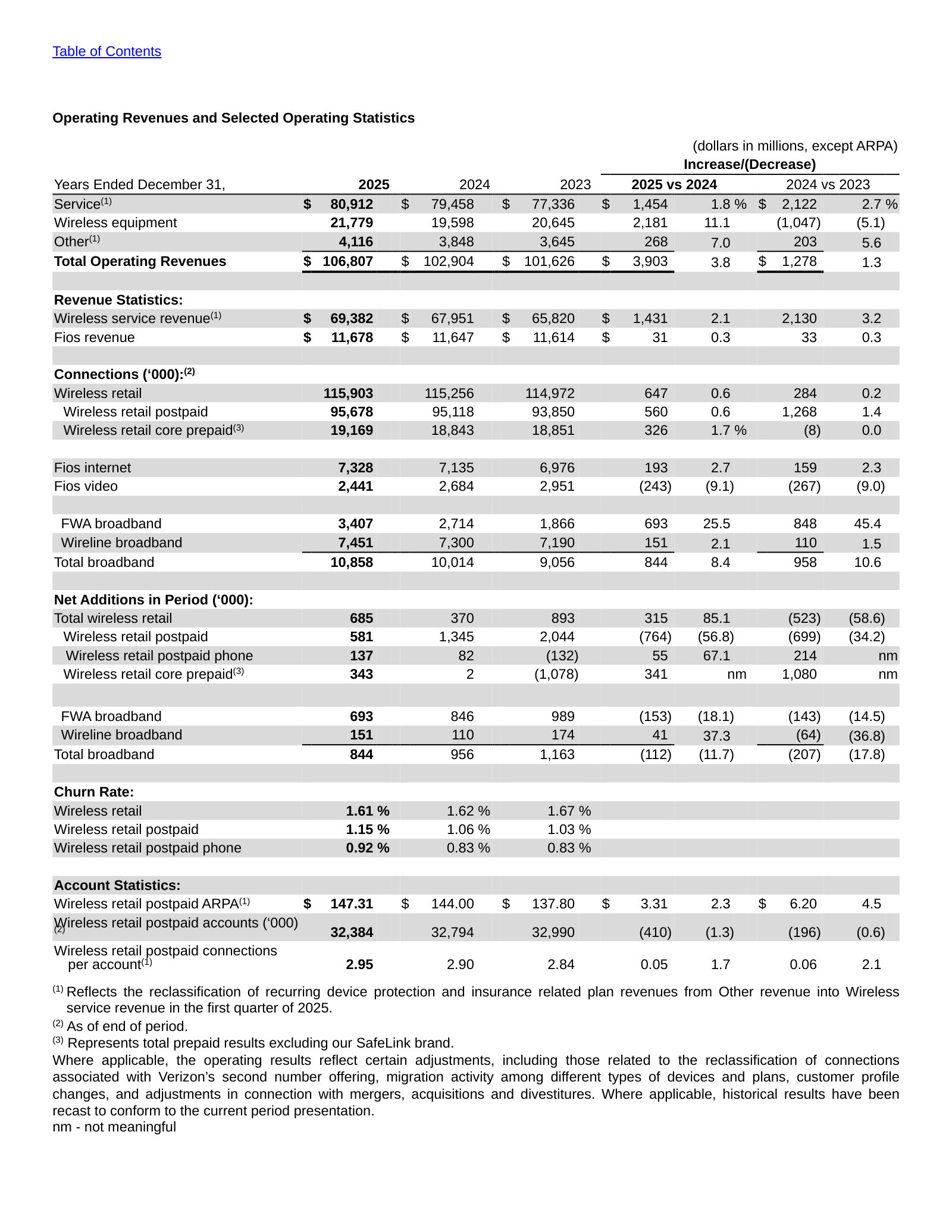
Where management explains 2025: two acquisitions reshaped the footprint, and Consumer statistics show where growth came from.
Frontier (fiber, 31 states) and Starry (FWA), both closed January 2026, expand the broadband footprint.
On January 20, 2026, we completed the acquisition of Frontier, a U.S. provider of broadband internet and other communication services. This transaction expanded our fiber broadband footprint to 31 U.S. states and Washington D.C., and provides opportunities for future growth. […] On January 30, 2026, we completed the acquisition of Starry, a fixed wireless broadband provider serving multi-dwelling units in five markets across the U.S. This transaction is expected to provide additional FWA capabilities and enhance our ability to deliver high-speed internet to multi-dwelling units and urban communities.
p. 42 · Read in context →
Critical Accounting Estimates — Wireless Licenses and Goodwill — p. 77 · Read the full section →
Spectrum is the business: $157B of wireless licenses carried as indefinite-lived and never amortized — an annual impairment judgment.
$157.0B of wireless licenses treated as indefinite-lived and tested for impairment rather than amortized.
Wireless licenses and goodwill are a significant component of our consolidated assets. Both our wireless licenses and goodwill are treated as indefinite-lived intangible assets and, therefore are not amortized, but rather are tested for impairment annually in the fourth fiscal quarter, unless there are events requiring an earlier assessment or changes in circumstances during an interim period suggesting impairment indicators are present. We believe our estimates and assumptions are reasonable and represent appropriate marketplace considerations as of the valuation date. Although we use consistent methodologies in developing the assumptions and estimates underlying the fair value calculations used in our impairment tests, these estimates and assumptions are uncertain by nature, may change over time and can vary from actual results. It is possible that in the future there may be changes in our estimates and assumptions, including the timing and amount of future cash flows, margins, growth rates, market participant assumptions, comparable benchmark companies and related multiples and discount rates, which could result in different fair value estimates. Significant and adverse changes to any one or more of the above-noted estimates and assumptions could result in an impairment to our wireless licenses and goodwill impairment for one or more of our reporting units. […] The carrying value of our wireless licenses was approximately $157.0 billion as of December 31, 2025. We aggregate our wireless licenses into one single unit of accounting, as we utilize our wireless licenses on an integrated basis as part of our nationwide wireless network. Our wireless licenses provide us with the exclusive right to utilize certain radio frequency spectrum to provide wireless communication services.
p. 77 · Read in context →
More annual reports
Verizon Communications Inc. — FY2024 Annual Report (Form 10-K) — FY2024 · 198 pages · The year before the Frontier deal and capital-return reset — the prior baseline for footprint, leverage and buyback posture. · Open →
Verizon Communications Inc. — FY2023 Annual Report (Form 10-K) — FY2023 · 198 pages · Peak C-Band build-out and deleveraging phase; useful for tracking capex and FWA ramp from an earlier point. · Open →
Verizon Communications Inc. — FY2022 Annual Report (Form 10-K) — FY2022 · 202 pages · First full year of C-Band 5G deployment and the debt peak that framed the years of capital discipline that followed. · Open →
Verizon Communications Inc. — FY2021 Annual Report (Form 10-K) — FY2021 · 187 pages · The $45B+ C-Band spectrum year that set up the wireless-license balance still central to the business today. · Open →